Giant Leaf Insect

Giant Leaf Insect

Phyllium giganteum
$20-50
Price
10-14 months for females; 6-8 months for males
Lifespan
Intermediate
Difficulty
Check availability & prices
View suppliers & Amazon options

About this species

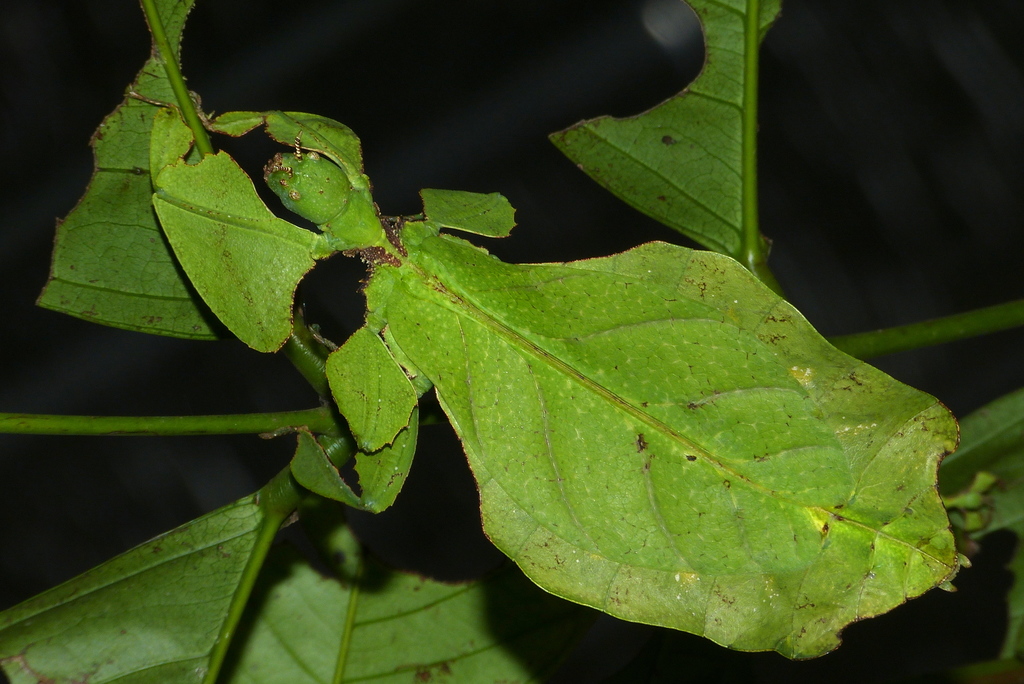
The Giant Leaf Insect is nature's masterpiece of disguise — a living, breathing leaf that walks. Native to the rainforests of Malaysia, these remarkable insects have evolved such perfect leaf mimicry that they're nearly impossible to spot in their natural habitat. Their flat, broad bodies are veined exactly like real leaves, complete with brown spots and irregular edges that mimic decay and insect damage. At 3-4 inches long, they're among the largest leaf insects in the world, and watching one slowly sway as it walks — mimicking a leaf in the breeze — is genuinely mesmerizing.

Unlike the more commonly kept Spiny Leaf Insect, Phyllium giganteum requires a bit more attention to humidity and food quality, which bumps it up from beginner to intermediate territory. They're more delicate during molting and need consistently fresh food plants. But the payoff is worth the extra effort — few insects in the hobby match the sheer 'wow factor' of a well-kept Giant Leaf Insect. They're the species that makes visitors do a double-take at your enclosure and say, 'Wait, that's alive?'

Giant Leaf Insects are surprisingly social and can be kept in small groups, which actually makes maintenance easier since you're already managing one enclosure of food plants. Females are the large, spectacular leaf mimics that everyone wants, while males are much smaller, slimmer, and capable of flight. Most hobbyists focus on all-female colonies produced through parthenogenesis, though introducing males creates genetic diversity that leads to healthier long-term populations.
Care requirements

Temperature
72-82°F (they're tropical and need consistent warmth; a gentle heat mat on one side works well if your room is cool)°F
Humidity
70-85%. Mist twice daily — morning and evening. They need higher humidity than most stick insects, but ventilation is still critical to prevent mold%
Enclosure
Tall mesh or glass-front vivarium with mesh top for ventilation. Height is key — at least 15 inches tall. Glass sides with a mesh top gives a good humidity/ventilation balance
Size
Minimum 12"L x 8"W x 15"H for 2-3 adults. Give them space — crowding increases molting failures
Substrate
Paper towels for easy egg collection, or a thin layer of coconut fiber. Eggs look like tiny brown seeds and drop to the floor
Diet
Bramble (blackberry/raspberry leaves) is the primary food. Also accept oak, guava, and mango leaves. Food must be very fresh — wilted leaves are often rejected. Keep cut stems in a water container with cotton around the top to prevent drowning
Water
No water dish. Mist leaves and enclosure walls twice daily — they drink droplets exclusively. Morning misting is especially important as they're often most active at dawn
Important notes
Molting is the critical danger point — ensure adequate height and textured surfaces for them to hang from. Never disturb a molting insect. Eggs require 5-9 months of incubation at 75-80°F on moist vermiculite. Nymphs are tiny and delicate — keep in smaller enclosures initially with very fine mesh

Did you know?

Giant Leaf Insect eggs look so much like plant seeds that even experienced keepers sometimes can't tell them apart from the real thing — which is exactly the point, since their natural strategy relies on ants mistaking them for seeds
The veining pattern on each Giant Leaf Insect's body is unique, much like a fingerprint, and actually changes slightly with each molt depending on humidity conditions during the process
Phyllium species were so prized by Victorian insect collectors that preserved specimens were displayed in cabinets alongside actual pressed botanical leaves, and guests were challenged to identify which was the real plant

Common questions

Why do my Giant Leaf Insects keep dying during molts?
Molting failures are the number one cause of death. Make sure the enclosure is tall enough (3x the insect's length minimum), humidity is at least 70%, and there's a rough surface or mesh at the top for them to hang from. Never disturb or handle them during or immediately after molting.
How do I incubate Giant Leaf Insect eggs?
Collect eggs from the enclosure floor, place them on moist (not wet) vermiculite or sphagnum moss in a sealed container with tiny air holes. Keep at 75-80°F and mist weekly. Be patient — hatching takes 5-9 months. You'll know they're viable if they don't mold or collapse.
Can I keep just females?
Yes — females reproduce through parthenogenesis, producing viable all-female offspring without mating. Many hobbyists maintain all-female colonies successfully. The trade-off is less genetic diversity, which can reduce hatching rates over multiple generations.

Related species

More stick insect species