About this species
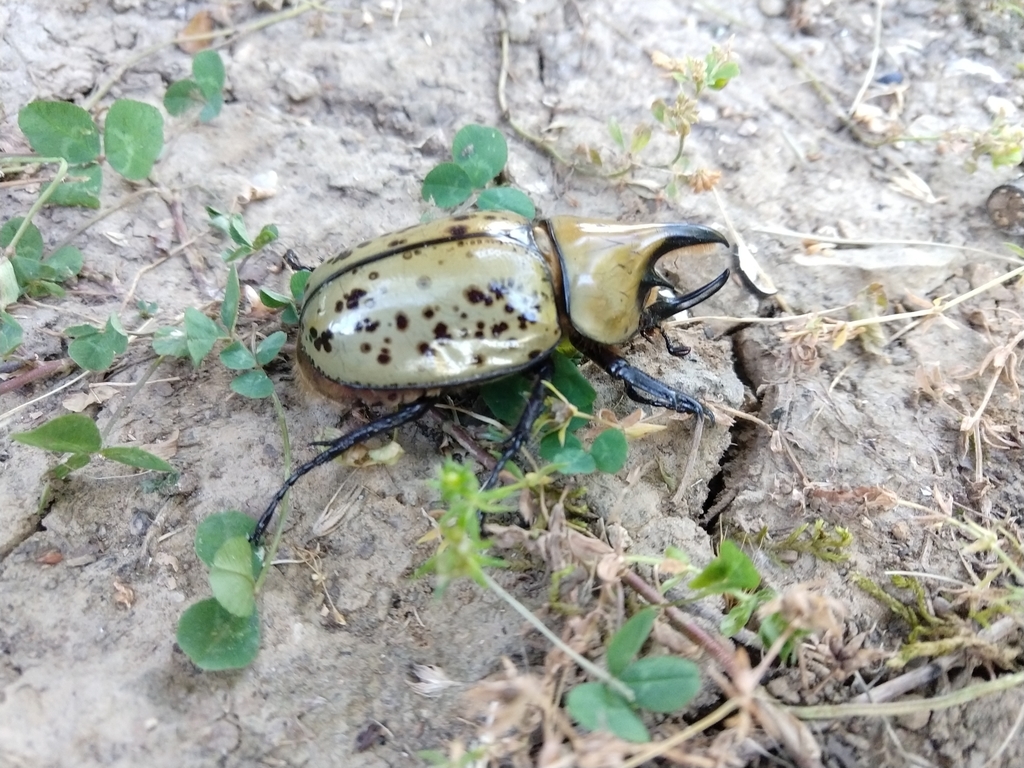
The Eastern Hercules Beetle is the largest beetle in the United States, and honestly, one of the most jaw-dropping insects you'll ever hold. Males sport massive pronotal and cephalic horns that can make them reach over 2.5 inches in total length — sometimes pushing past 3 inches for exceptional specimens. Their elytra range from olive-green to tan or yellowish, often speckled with dark brown or black spots, and the color actually shifts with humidity levels. They're native to the eastern US, ranging from the Gulf states up through the mid-Atlantic, where larvae develop in rotting hardwood logs and stumps.
These beetles are a gateway into the rhinoceros beetle hobby for US keepers because they're native, legal to keep in all states without permits, and genuinely impressive. Males will spar with those huge horns if housed together, which is entertaining to watch but means you should house adult males separately. They're surprisingly docile to handle — they'll grip your fingers with their tarsi but rarely if ever try to pinch. Adults are primarily active at dusk and night and are strongly attracted to lights, which is actually how many wild specimens are collected.
Most people buy Dynastes tityus as larvae (L2 or L3 grubs), since that's where the bulk of the fun is — watching a fat grub the size of your thumb transform into an armored tank of a beetle. Be aware that the larval stage is long, typically 12-18 months, sometimes longer in cooler conditions. Patience is absolutely part of this hobby, but the payoff when that adult ecloses is unbeatable.
Did you know?
Eastern Hercules Beetles can lift up to 100 times their own body weight, making them proportionally one of the strongest animals on Earth.
Their elytra act like a living mood ring — the green-yellow coloring darkens to almost black in high humidity and lightens again when conditions dry out, due to moisture filling microscopic layers in the shell.
Wild males sometimes fly to porch lights on warm summer nights in the southeastern US, occasionally terrifying homeowners who aren't expecting a 3-inch horned beetle to land on their screen door.
Common questions
How do I tell male and female larvae apart?
In L3 larvae, you can sex them by looking at the ventral side of the last abdominal segment. Males have a small, faint oval marking (the Herold organ) on the inside of the segment. It takes practice to spot, but once you see it on one, you'll recognize it on others. Females lack this mark entirely. Males also tend to be larger by late L3.
Can I speed up the larval stage?
Warmer temperatures (mid to upper 70s°F) and consistently fresh, high-quality substrate will keep growth moving along, but there's no real shortcut. Larvae kept cooler or in depleted substrate may take over two years to develop. The best thing you can do is keep substrate fresh and temps stable — don't try to heat them above 80°F to rush things, as that stresses them and can reduce adult size.
How big will my adult beetle be?
Adult size is determined almost entirely during the larval stage. Well-fed L3 larvae with plenty of high-quality flake soil and stable conditions produce the biggest adults. Males typically range from 1.6 to 2.8 inches, with the horn making up a significant portion. Genetics play a role too — breeding from larger parents tends to yield larger offspring over generations.